Sources checked 27 October 2026. The salaries, budgets and amounts below are worked examples, not financial advice or a forecast of what you will save.
Payday arrives on the 25th. By the 3rd, rent and the car payment have gone out. Groceries, fuel and a phone bill follow. There is a dinner with friends, a birthday present, a jacket that was half price. On the 24th you open the banking app to move "whatever is left" into savings, and the number is small enough that moving it feels pointless. Next month, you tell yourself.
Nothing in that month was reckless. Each purchase was reasonable when it was made. The problem is the order. Saving was scheduled for the one day of the month when there was least money to save and the most practice at spending it.
Paying yourself first reverses that order. A fixed amount leaves for savings on payday, before the month begins, and the budget is whatever remains. The idea is old. George Clason's 1926 parable The Richest Man in Babylon built its first lesson around keeping "a part of all you earn," at least a tenth, before paying anyone else. [1] What is newer is the evidence for why the order matters.
Same paycheck, opposite order
Take two people who each earn $4,000 a month after tax.
The first spends through the month and plans to save what remains. Some months that is $300. Some months it is nothing, because the car needed tyres or a friend got married. Every month, saving is a fresh decision made at the end, when the balance is lowest.
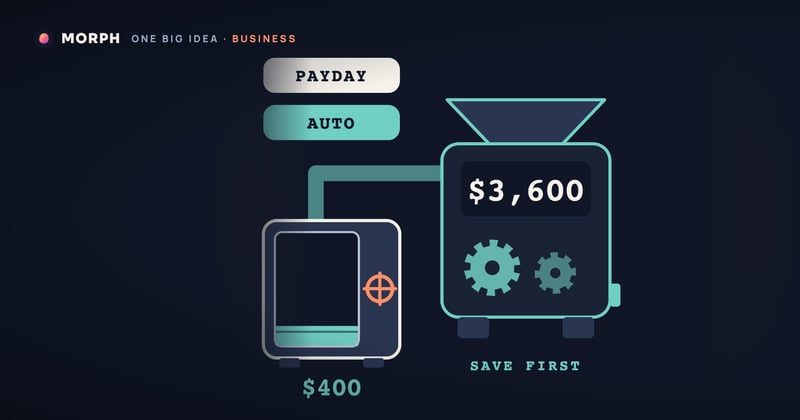
The second has a standing transfer of $400 that leaves on payday. The remaining $3,600 is the budget. When the tyres need replacing, that cost competes with dinners and new clothes, not with savings.
Illustrative model of a $4,000 month: $2,300 of essentials, $1,400 of flexible spending when saving last, and three $600 surprises. Assumptions, not data.
Neither person earns more. The second has simply moved the decision from the 24th, when it is hard, to one afternoon when it was easy.
Why the leftovers rarely appear
Saving last asks for the same act of restraint twelve times a year, each time with the money visibly available. Money in a current account tends to look like spending money. Richard Thaler's work on mental accounting describes how people sort money into informal categories and treat each category differently, even though a dollar is a dollar. [2] Money that has already been moved into an account labelled "savings" is harder to think of as this month's money. Money still sitting in the account you pay for groceries from is easy to think of that way.
There is also a timing problem. On payday the choice is abstract: put aside $400 for a future you. On the 24th, the choice is concrete and the competition is immediate: the $400 against the plans you have already made.
Paying yourself first does not make you more disciplined. It reduces how often discipline is needed.
What happens when saving becomes the default
The strongest evidence for this idea comes from retirement plans, where economists could watch thousands of people make the same choice under different defaults.
In 2001, Brigitte Madrian and Dennis Shea studied a large U.S. company that changed its 401(k) plan. Before the change, new employees had to sign up to start saving. Afterwards, they were enrolled automatically and had to opt out to stop. Among employees with similar length of service, participation rose from 37% under the old rules to 86% under automatic enrollment. [3] The plan, the employer match and the investment choices were the same. The default had changed.
The same study found a cost. Most automatically enrolled employees stayed at the default contribution rate of 3% of pay and in the default money-market fund, even though many of them would probably have chosen to contribute more if they had enrolled themselves. A default is powerful in both directions: it can get people saving, and it can keep them saving too little.
Madrian & Shea (2001). Participation among employees with 3–15 months of service at one U.S. company, before (37%) and after (86%) automatic enrollment.
Shlomo Benartzi and Thaler designed a program that used that inertia on purpose. In Save More Tomorrow, employees agreed in advance to raise their contribution rate each time they received a pay rise. In the first company to use it, participants' average saving rate rose from 3.5% to 13.6% over about 40 months. [4] The increases were scheduled for moments when take-home pay was rising anyway, so nobody had to accept a smaller paycheck. A later U.S. Department of Labor evidence review rated the study's causal evidence as low, because people chose whether to join and could differ from those who did not. [5] The result is encouraging, but it is not proof that the same design works for everyone.
Thaler & Benartzi (2004), first implementation; only the published points are plotted. “Your numbers” is arithmetic that ignores taxes and inflation.
Neither study tested a personal transfer to a savings account. They tested defaults inside workplace retirement plans. The shared mechanism is the one that matters here: when saving happens unless you act, far more of it happens.
Does saving first just move the problem?
A reasonable worry is that money saved automatically comes back as debt. If $400 leaves on payday and the month still costs $4,000, the difference may end up on a credit card.
Researchers checked this in one large case. When the U.S. Army introduced automatic enrollment in its retirement savings plan, John Beshears and colleagues compared the Army's civilian employees hired just before and just after the change. About four years later, automatic enrollment had raised savings without a significant increase in credit card balances or other debt outside car loans and mortgages. They could not rule out some extra borrowing for cars and first homes, which comes with owning something. [6] That is reassuring, but it is one group of employees with steady government pay.
The practical lesson is to choose an amount the month can actually support. Paying yourself first works when the transfer comes out of discretionary spending. It does not work when it comes out of rent and the gap goes on a card charging 25% interest. If you carry high-interest debt, paying it down is often the better first use of that payday transfer, because each payment earns a guaranteed return equal to the interest rate.
Setting it up
Start with the essentials. List the bills that must be paid this month: housing, utilities, food, transport, minimum debt payments. Pick a transfer that leaves those covered with some room for the ordinary surprises. If that number is $50, start with $50. A small transfer that keeps running teaches you more than a large one you cancel in March.
Worked example, not financial advice. The cushion is 5% of take-home pay; the suggested start is half of the remaining room.
Schedule it for the day your pay arrives. If your bank allows it, make it a standing order rather than a reminder. The point is that it happens without asking you again.
Send it somewhere slightly out of reach. A separate savings account, ideally one that does not appear on the same screen as your spending account, keeps the money out of the mental category of "available this month." Many people find an emergency fund the most useful first destination.
Raise it when your income rises. The Save More Tomorrow design is easy to copy at home. When you get a pay rise, increase the transfer by part of the increase before you start spending the new amount. You never see the money as part of your spending, so you never feel it taken away.
Review it every few months. If the transfer keeps pushing you into overdraft or onto a credit card, it is set too high. Lower it rather than abandoning it. The habit of the order is worth more than any particular amount.
The question to ask on payday
Most saving advice asks how much you can save. Paying yourself first asks a different question: what if saving happened before you had to decide?
The evidence does not say that one transfer will make anyone wealthy, or that a fixed percentage is right for every household. It does say that the order of decisions changes behaviour, often more than intentions do. Pick an amount you can keep paying, put it on payday, and let the month adjust to what remains.
Sources
[1] George S. Clason, The Richest Man in Babylon (1926). A collection of parables; its "a part of all you earn is yours to keep" lesson is popular advice, not research.
[2] Richard H. Thaler, "Mental Accounting Matters" (1999). Journal of Behavioral Decision Making, 12(3), 183–206. A review of how people categorise and track money.
[3] Brigitte C. Madrian & Dennis F. Shea, "The Power of Suggestion: Inertia in 401(k) Participation and Savings Behavior" (2001). Quarterly Journal of Economics, 116(4), 1149–1187. One U.S. employer; participation compared across cohorts before and after automatic enrollment.
[4] Richard H. Thaler & Shlomo Benartzi, "Save More Tomorrow: Using Behavioral Economics to Increase Employee Saving" (2004). Journal of Political Economy, 112(S1), S164–S187. Participants chose to join; saving rates from the first implementation.
[5] U.S. Department of Labor, Clearinghouse for Labor Evaluation and Research (CLEAR), review of Thaler & Benartzi (2004). Rates the causal evidence as low because of self-selection into the program.
[6] John Beshears, James J. Choi, David Laibson, Brigitte C. Madrian & William L. Skimmyhorn, "Borrowing to Save? The Impact of Automatic Enrollment on Debt" (2022). Journal of Finance, 77(1), 403–447. U.S. Army civilian employees; outcomes about four years after hire.
Watch the episode
One email when we publish. Research, product decisions, and what teams report back.