Sources checked 31 October 2026. The two students and the study plan below are worked examples, not data; the percentages are published results.
Two students sit down with the same chapter the night before a quiz. The first reads it, then reads it again, and again. By the fourth pass the sentences glide by. Every paragraph looks familiar, and she feels ready.
The second student reads the chapter once. Then she closes the book, takes a blank page and writes down everything she can remember. It's slow. There are holes: a date she can't place, a step she knows exists but can't name. When she runs out, she opens the book, checks what she got wrong, and fills in the gaps.
If you asked them that evening, the first student would probably say she studied better. A week later, the evidence suggests the second one often remembers more.
What is the testing effect?
The testing effect (also called retrieval practice) is the finding that pulling information out of memory tends to strengthen it more than putting the same information in again. A test, in this sense, isn't a grade. It's any moment when you try to produce an answer without looking: a blank page, a flashcard, a question you answer out loud.
The idea is more than a century old, but the modern wave of research took off with a short paper by Henry Roediger and Jeffrey Karpicke at Washington University in St. Louis, published in 2006 [1]. Its title says it plainly: taking memory tests improves long-term retention.
What did the 2006 study actually find?
In their second experiment, 180 students read a short prose passage (about 250 to 275 words, on topics such as sea otters or the sun) in one of three ways [1]:
SSSS: four study periods of 5 minutes each. Read, read, read, read.
SSST: three study periods, then one recall test: write down everything you remember.
STTT: one study period, then three recall tests.
Nobody got feedback on their tests. Then half of each group took a final recall test 5 minutes later, and the other half came back a week later.
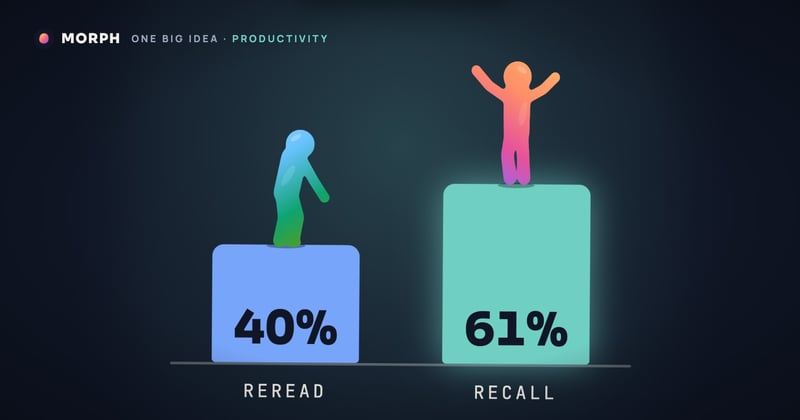
Published means from Roediger & Karpicke (2006), Experiment 2: 180 undergraduates, a short prose passage, free recall with no feedback. Proportion of idea units recalled on the final test.
Five minutes after studying, the rereaders were ahead: 83% of the passage recalled in the SSSS group, against 71% in the STTT group. A week later the order flipped. The rereaders recalled 40%, the single-test group 56% and the repeated-test group 61% [1].
Notice how lopsided the effort was. The rereading group read the passage about 14 times in total, the repeated-test group about 3 times [1]. Fewer readings, more recall attempts, better memory a week later.
The first experiment, with 120 students, showed the same crossover with one extra study period versus one test: rereading won at 5 minutes (81% vs 75%), testing won at 2 days (68% vs 54%) and at a week (56% vs 42%) [1].
Why does rereading feel better if it works worse?
The most striking number in the paper isn't a recall score. Before leaving, students rated how well they expected to remember the passage in a week, on a 1 to 7 scale. The rereaders were the most confident (4.8), the repeated-test group the least (4.0) [1]. Their predictions ran opposite to what happened.
Rereading makes a text fluent: the words are easy to process because you've just seen them. That ease is real, but it's a feeling about the page in front of you, not a measure of what you could produce with the page gone. Recalling from a closed book removes the page, so you see your gaps right away. It feels worse because it's honest.
Each card states a common belief, then what the studies cited in this article found. Tap a card to flip it.
This is why the testing effect is easy to ignore. The method that feels productive in the moment and the method that tends to pay off later are often not the same one.
Why can struggling help you learn?
The psychologist Robert Bjork has a name for this kind of effort: desirable difficulties [2]. Some conditions slow you down during practice and make you feel less fluent, yet improve long-term retention. Retrieval is one of the clearest examples.
The struggle seems to matter even when you fail. In a set of experiments, Nate Kornell, Matthew Hays and Robert Bjork had people try to guess an answer before being shown it. Those failed attempts, followed by the correct answer, often led to better memory than simply studying the answer for the whole time [3]. A wrong guess is not wasted if it's followed by the right answer.
That "followed by" is important. Roediger and Karpicke gave no feedback, so students could only strengthen what they managed to recall. Later work by Andrew Butler and Roediger found that feedback after a test increased its benefits and helped correct errors [4]. That's why the second student in our example checks her mistakes: recall first, then look.
A worked example of a close-write-check routine built on the research in this article. Not a tested protocol.
How strong is the evidence, and where are its limits?
The testing effect is one of the better-replicated findings in learning research, but it isn't magic, and it isn't the same size everywhere.
Across many studies, the average effect is moderate. A meta-analysis by Christopher Rowland combined 159 effect sizes from 61 studies comparing testing with restudy. The average was g = 0.50, and 81% of the effects favoured testing [5]. Published studies showed a larger effect (0.58) than unpublished ones (0.25), a reminder that published numbers can overstate things.
Recall tends to beat recognition. In the same analysis, initial tests that asked people to produce answers (recall) gave larger benefits than multiple-choice style recognition tests [5].
The 2006 study was small and specific. Undergraduates, short passages from a test-prep book, free recall, a one-week delay. It didn't test long textbooks, maths problems, or exams months later.
Short-term results can mislead. If your test is in five minutes, rereading may look better, as it did in the study. The advantage of recall shows up with a delay.
If you recall almost nothing, add feedback. Without it, you only strengthen what you managed to retrieve [4] [5].
A widely cited review by John Dunlosky and colleagues rated ten common study techniques. Practice testing was one of only two rated "high utility"; rereading was rated "low utility" [6]. That review is a judgement by experts across many studies, not a single experiment, but it points the same way.
How do you use it tonight?
You don't need special software. You need a closed book and a blank page.
Read a section once, carefully. One good pass, not four quick ones.
Close it and write what you remember. Key ideas, in your own words. Don't peek, even when it gets hard; the hard part is the useful part.
Check against the book. Mark what you missed or got wrong, and reread only those parts.
Recall again later. Tomorrow, or in a few days, try again from a blank page before you open the book.
Illustrative planner: it splits your time between reading, recalling and checking. The split is a rule of thumb, not a published ratio.
If you only have time for one change, make it this: before you reread anything, try to recall it first. You'll feel less ready. That feeling is often the sign that the learning is happening.
Retrieval practice on this article itself. Answer from memory first, then check the explanation.
Sources
Roediger, H. L., & Karpicke, J. D. (2006). Test-enhanced learning: Taking memory tests improves long-term retention. Psychological Science, 17(3), 249–255. doi:10.1111/j.1467-9280.2006.01693.x — Two lab experiments (120 and 180 undergraduates), short prose passages, free recall without feedback, final tests up to one week later. Not tested: long materials, other subjects, longer delays.
Bjork, R. A. (1994). Memory and metamemory considerations in the training of human beings. In J. Metcalfe & A. Shimamura (Eds.), Metacognition: Knowing about knowing (pp. 185–205). MIT Press. — A theoretical chapter introducing "desirable difficulties"; it frames the idea rather than testing retrieval directly.
Kornell, N., Hays, M. J., & Bjork, R. A. (2009). Unsuccessful retrieval attempts enhance subsequent learning. Journal of Experimental Psychology: Learning, Memory, and Cognition, 35(4), 989–998. doi:10.1037/a0015729 — Lab studies with word pairs and trivia-style items; the failed guess was always followed by the correct answer.
Butler, A. C., & Roediger, H. L. (2008). Feedback enhances the positive effects and reduces the negative effects of multiple-choice testing. Memory & Cognition, 36(3), 604–616. doi:10.3758/MC.36.3.604 — Multiple-choice tests on prose passages; shows the role of feedback, not the size of the testing effect in classrooms.
Rowland, C. A. (2014). The effect of testing versus restudy on retention: A meta-analytic review of the testing effect. Psychological Bulletin, 140(6), 1432–1463. doi:10.1037/a0037559 — 159 effect sizes from 61 studies (1975–2013); high heterogeneity between studies, and a smaller effect in unpublished work.
Dunlosky, J., Rawson, K. A., Marsh, E. J., Nathan, M. J., & Willingham, D. T. (2013). Improving students' learning with effective learning techniques. Psychological Science in the Public Interest, 14(1), 4–58. doi:10.1177/1529100612453266 — An expert review rating ten techniques; the utility ratings are judgements across studies, not new data.
Watch the episode
One email when we publish. Research, product decisions, and what teams report back.