Sources checked 31 October 2026. The student and the difficulty model below are worked examples, not data; the percentages are published results.
Picture a student three weeks before a maths exam. Every evening she opens the same practice sheet: twenty questions, always in the same order, always worded the same way. By the second week she can do it in her sleep. Question 7 is the one with the train. Question 12 wants the formula from page 40. Twenty out of twenty, night after night.
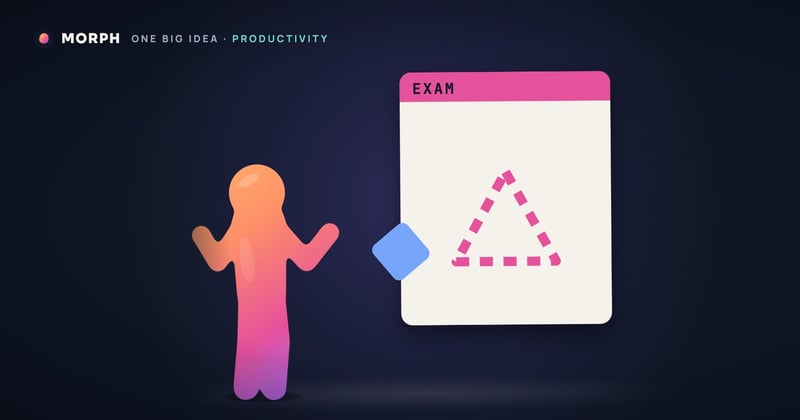
Then the exam arrives. The idea behind question 7 is there, but the train has become a water tank, the numbers sit in a table instead of a sentence, and the question asks for the time instead of the speed. She stares at it. Everything she "knew" seems to have stayed on the practice sheet.
Nothing about her effort was fake. She worked hard and she improved at something. The trouble is what she improved at: answering those twenty questions in that format. The exam measured something else.
Why can easy practice feel like learning?
Psychologists separate two things that are easy to mix up. Performance is what you can do during or right after practice: how fast, how accurately, how smoothly. Learning is the lasting change that shows up later, after a delay, or in a new situation. Nicholas Soderstrom and Robert Bjork reviewed decades of studies on this split in 2015 and found that the two often come apart: learning can happen without a visible jump in performance, and big gains in performance often fail to last [3].
Practice that repeats the same questions in the same form is very good for performance. Each round feels smoother. You start to recognize the question before you've finished reading it. That recognition is real, but it is a cue for the answer, and the exam may not give you the same cue.
The feeling of ease has a name in this research: fluency. When information is fluent, it feels known. The catch is that fluency is a signal about the material in front of you, not a reliable measure of what you'll be able to do next week with different material.
What did Bjork mean by "desirable difficulties"?
In a 1994 chapter on how people are trained, the UCLA psychologist Robert Bjork described a pattern that runs against intuition [1]. Some conditions that make practice harder and slower in the moment tend to produce better long-term retention and better transfer to new situations. He called them desirable difficulties.
The examples he and later researchers kept returning to include:
Spacing: spreading practice of the same thing across days instead of massing it into one session.
Varying the conditions: practising the same skill in slightly different forms, settings or wordings.
Interleaving (mixing): shuffling different kinds of problems together instead of doing ten of the same kind in a row.
Testing yourself: trying to produce the answer from memory instead of looking at it again.
Each one makes practice feel worse. You forget a bit between spaced sessions, so the start is shaky. Mixed problems make you work out which method fits before using it. A blank page shows your gaps. That struggle is part of why these methods tend to work: you rebuild and reorganise what you know, instead of riding the cues of the last attempt [1][6].
The word that matters is desirable. Bjork never argued that harder is always better. The model below is a sketch of that idea, not data: drag the slider to see why a little difficulty can help, and why too much doesn't.
Illustrative model, not data: how a practice score and a later score might change with difficulty, and how the useful zone moves with what you already know.
What happened to the kids with the beanbags?
One of the studies Bjork's group often uses to explain the idea comes from a school gym, not a lab. In 1978, Robert Kerr and Bernard Booth gave children a new throwing task: toss a small beanbag at a target on the floor [2].
Among the 8-year-olds, one group practised only from 3 feet, the exact distance of the final test. The other group never practised from 3 feet at all. They threw from 2 feet and from 4 feet. The study ran over a 12-week physical education programme, and the two groups started out equal.
At the final test, from 3 feet, the varied group was more accurate than the group that had practised that very distance. The 12-year-olds showed the same pattern with different distances (4 feet for the specific group, 3 and 5 feet for the varied group) [2].
Step through it below.
Design of Kerr & Booth (1978): 64 children aged 8 and 12, a 12-week PE programme. The throw arcs are a diagram; the paper reports the varied groups as significantly more accurate.
Keep the limits in view. This is a motor task with children, one study, and it was summarised by its authors through motor schema theory. The varied distances bracketed the test distance, which matters: variation that surrounds the target is not the same as random variety. It doesn't prove that every kind of variation helps every learner. It is a vivid example of the general point: practising the exact form of the test can be less useful than practising around it.
Why do learners pick the easy way anyway?
If spacing and mixing help, why does almost everyone mass and block? Partly because of how it feels.
In 2008, Nate Kornell and Robert Bjork asked people to learn the painting styles of 12 artists. Some artists' paintings were shown in a block, one after another. Others were spread out and mixed with other artists. Then participants had to name the artist of paintings they had never seen. Spacing helped most people, and yet most of them believed the massed blocks had helped them more [4].
A larger replication by Peter Verkoeijen and Samantha Bouwmeester in 2014 found the same split [5]. Try to predict it before you look.
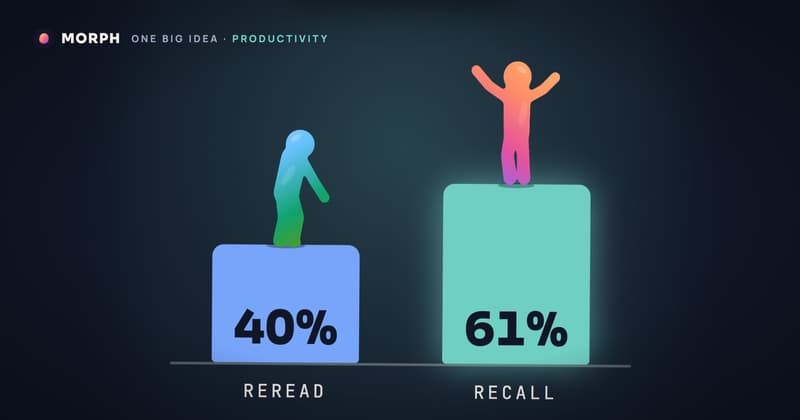
Published results from Verkoeijen & Bouwmeester (2014), a replication of Kornell & Bjork (2008) with 123 participants: judgements of which presentation helped most, and hit rates on the first test block.
That gap between what helps and what feels like it helps is the heart of this topic. The easy method feels productive because it is productive in the moment. Your judgement of learning is reading your current performance, and current performance is the thing that misleads [3][4].
Is every difficulty desirable?
No, and the researchers who coined the term are clear about it. Elizabeth Bjork and Robert Bjork wrote in 2011 that a difficulty is desirable only if you can respond to it successfully. If you don't yet have the background knowledge to meet it, it becomes an undesirable difficulty [6]. A beginner who is thrown into a fully mixed problem set with no idea how any of the methods work is not doing deep learning. They're just stuck.
So the useful rule is closer to this: once you can do something in the easy form, change the form before it becomes automatic.
How strong is the evidence? It differs by technique:
Technique | What the reviews say |
|---|---|
Spacing (distributed practice) | A large review of hundreds of experiments found spaced practice usually beat massed practice for later recall [7]. Rated high utility in a 2013 expert review [8]. |
Testing yourself | Rated high utility in the same review [8]. |
Interleaving (mixing) | Rated moderate utility: promising, with fewer studies and mostly in maths and categories [8]. |
Rereading, highlighting | Rated low utility as main strategies [8]. |
Two more limits. Many of these studies used lab materials, short sessions and delays of days or weeks, not a full course. And the benefits are usually measured later: if your exam is tomorrow morning, tonight's spaced plan has little room to work. The idea is best used as a habit across weeks, not as an emergency fix.
How do you make your practice harder in a good way?
You don't need a new system. Small changes to what you already do are enough:
Reword a question you can already answer. Change the numbers, the context, or what it asks for. If you solved for speed, solve for time. If the data was in a sentence, put it in a table.
Answer it cold. Close the notes, wait a day, then try. A slow, shaky answer is useful information; it tells you what to review.
Mix the set. Once you can do each type alone, shuffle them so you must decide which method fits before you start.
Space the repeats. Come back to a topic after a gap of a day or more instead of doing it five times tonight.
Check after you try. Feedback turns a wrong attempt into a lesson. Struggle without ever finding out the answer is just frustration.
And treat the feeling of ease with a little suspicion. When a practice sheet starts to feel effortless, that is not the moment to keep repeating it. It is the moment to change it.
Before you go, answer these from memory.
Three questions on this article. Explanations cite the sources listed below.
Sources
Bjork, R. A. (1994). Memory and metamemory considerations in the training of human beings. In J. Metcalfe & A. Shimamura (Eds.), Metacognition: Knowing about knowing (pp. 185–205). MIT Press. — A theoretical chapter that introduced the term "desirable difficulties"; it frames the idea and reviews evidence rather than reporting a single new experiment.
Kerr, R., & Booth, B. (1978). Specific and varied practice of motor skill. Perceptual and Motor Skills, 46(2), 395–401. — 64 children aged 8 and 12, a beanbag-throwing task within a 12-week PE programme; a motor skill, a single study, and the varied distances bracketed the test distance.
Soderstrom, N. C., & Bjork, R. A. (2015). Learning versus performance: An integrative review. Perspectives on Psychological Science, 10(2), 176–199. doi:10.1177/1745691615569000 — A narrative review of motor and verbal learning studies; it synthesises existing work rather than adding new data.
Kornell, N., & Bjork, R. A. (2008). Learning concepts and categories: Is spacing the "enemy of induction"? Psychological Science, 19(6), 585–592. doi:10.1111/j.1467-9280.2008.02127.x — Lab experiments with undergraduates learning artists' painting styles; one kind of category learning, short delays.
Verkoeijen, P. P. J. L., & Bouwmeester, S. (2014). Is spacing really the "friend of induction"? Frontiers in Psychology, 5, 259. doi:10.3389/fpsyg.2014.00259 — A web-based replication of Kornell & Bjork's second experiment with 123 participants; it found a medium-sized spacing benefit, similar to the original.
Bjork, E. L., & Bjork, R. A. (2011). Making things hard on yourself, but in a good way: Creating desirable difficulties to enhance learning. In M. A. Gernsbacher et al. (Eds.), Psychology and the real world (pp. 56–64). Worth. — An accessible essay by the researchers; it summarises evidence and sets the "respond successfully" condition.
Cepeda, N. J., Pashler, H., Wixted, J. T., Rohrer, D., & Rothstein, A. A. (2006). Distributed practice in verbal recall tasks: A review and quantitative synthesis. Psychological Bulletin, 132(3), 354–380. doi:10.1037/0033-2909.132.3.354 — Verbal recall tasks, mostly in labs; the best gap depends on how long you need to remember.
Dunlosky, J., Rawson, K. A., Marsh, E. J., Nathan, M. J., & Willingham, D. T. (2013). Improving students' learning with effective learning techniques. Psychological Science in the Public Interest, 14(1), 4–58. doi:10.1177/1529100612453266 — An expert review rating ten techniques; the utility ratings are judgements across studies, not new data.
Watch the episode
One email when we publish. Research, product decisions, and what teams report back.