Sources checked 31 October 2026. The race and the examples below are illustrations, not data; the medal numbers are the published means.
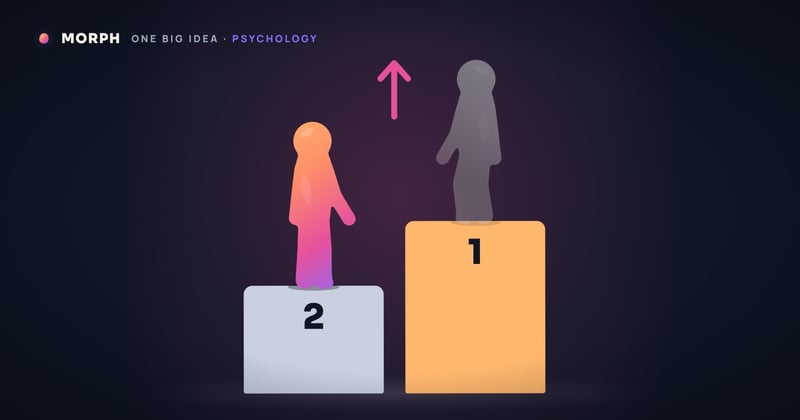
Two runners line up for a final. Maya crosses the line one second behind the winner. Sam finishes last, a long way back. An hour later, Sam is joking with his friends about the burger he plans to eat. Maya is sitting on a bench replaying the start in her head: if only I'd gone off the blocks faster.
On paper, Maya did far better. So why is she the one who's hurting?
What is counterfactual thinking?
A counterfactual is a thought about something that didn't happen: "if only I had…", "I almost…", "at least I didn't…". The word means "contrary to the facts". We produce these thoughts all the time, mostly without noticing, and they don't just describe the past. They change how the past feels.
The key point is that we rarely judge an outcome on its own. We judge it against an alternative our mind supplies, and the alternative that comes to mind most easily sets the emotional tone. For Maya, the alternative that jumps out is "I win." For Sam, it might be "I don't finish at all," or nothing much, because no single small change would have turned his race into a win.
Why do near misses hurt the most?
In a classic thought experiment, Daniel Kahneman and Amos Tversky described two travellers, Mr Crane and Mr Tees, who share a taxi to the airport, get stuck in traffic, and arrive 30 minutes after their flights' scheduled departure. Mr Crane is told his flight left on time. Mr Tees is told his flight was delayed and left only five minutes ago. Who is more upset? Almost everyone they asked (96%) said Mr Tees [1].
Both men missed their flight, and both missed it for the same reason. The difference is how easy it is to imagine it going the other way. Five minutes feels undoable: one green light, one shorter queue. Thirty minutes doesn't. Kahneman and Tversky called this mental "undoing" of events the simulation heuristic: the easier the alternative is to simulate, the stronger the feeling attached to it.
Illustrative model of the idea that closer misses make the alternative easier to imagine (after Kahneman & Tversky, 1982). The curve is not data.
That's Maya's problem. One second is easy to undo in her head, so the imaginary win feels close enough to touch, and the real result feels like a loss of something she nearly had.
The Olympic medal study
The best-known evidence for this comes from the Olympics. Victoria Medvec, Scott Madey and Thomas Gilovich showed students television footage of medalists at the 1992 Barcelona Games and asked them to rate how happy each athlete looked, from 1 ("agony") to 10 ("ecstasy") [2].
Silver is objectively better than bronze. But right after their events, bronze medalists were rated as looking happier on average (7.1) than silver medalists (4.8). On the podium later, the gap was smaller but in the same direction (5.7 for bronze, 4.3 for silver).
Published means from Medvec, Madey & Gilovich (1995), Study 1: observers rated 1992 Olympic medalists' expressions on a 1–10 scale (1 = agony, 10 = ecstasy).
The authors' explanation was counterfactual thinking. A silver medalist is one place away from gold, so the natural comparison is upward: "I almost won." A bronze medalist is one place away from no medal at all, so the natural comparison is downward: "at least I got a medal." In a second study, raters coded the athletes' interview comments, and silver medalists' remarks leaned more towards "I almost…" thoughts than bronze medalists' did. A third study asked athletes at a US state-level competition directly, with a similar pattern [2].
How solid is the finding?
Reasonably, but with limits worth knowing.
It measured looks, mostly. Study 1 rated facial expressions on TV, judged by observers. That's not the same as asking athletes how they felt, and it captures minutes, not months.
Expectations matter too. Peter McGraw, Barbara Mellers and Philip Tetlock argued that athletes compare their result with what they expected, not only with the next place up. A silver medalist who expected bronze can be delighted; one who expected gold can be crushed. In their own data they did not find the same bronze-over-silver reversal [3].
A larger replication supported both views. In 2021, William Hedgcock, Andrea Luangrath and Raelyn Webster used automated facial coding on podium photos of 413 athletes from the 2000–2016 Summer Games. Bronze medalists were more likely to smile than silver medalists, and the data fitted both the "next place up" and the "expectations" accounts [4].
So the honest version is: near misses often sting more than clearer defeats, and the comparison your mind picks, shaped partly by what you expected, does much of the work. It isn't a law that silver always feels worse.
Is "if only" always bad?
No, and this is the useful part. Psychologist Neal Roese has argued that counterfactuals have a job [5]. Upward ones ("if only I had studied more") feel worse but point at something you could change. In his experiments, people prompted to think upward counterfactuals reported stronger intentions to improve and, on a repeated task, did better than those prompted to think downward ones. Downward counterfactuals ("at least I passed") feel better but teach less [5][6].
Worked examples of upward ('if only') and downward ('at least') counterfactuals, based on the functional view in Roese (1994) and Epstude & Roese (2008). Not data.
The problem isn't the "if only". It's the loop: the same upward thought replayed again and again without turning into a plan. That's where the pain comes from the race that never happened rather than the race you actually ran.
What can you do with it?
When an "if only" keeps replaying, try three moves.
Ask "at least what?" Not to pretend the loss doesn't matter, but to put the real result back in proportion. Maya made a final. Most runners never do.
Check whether the "if only" is controllable. "If only it hadn't rained" teaches nothing. "If only I'd started faster" is something you can train.
Pick one fix. Turn the strongest controllable counterfactual into one concrete change for next time, then let the replay stop. You've taken what it had to teach.
A simple self-help exercise based on the ideas in this article. It is not a validated test or therapy.
Next time you feel worse about nearly winning than you would about losing badly, notice which imaginary outcome you're comparing yourself to. The feeling is real. The race it's measuring against never happened.
Sources
Kahneman, D., & Tversky, A. (1982). The simulation heuristic. In D. Kahneman, P. Slovic & A. Tversky (Eds.), Judgment under uncertainty: Heuristics and biases (pp. 201–208). Cambridge University Press. A hypothetical scenario answered by students; it shows what people predict others would feel, not measured feelings.
Medvec, V. H., Madey, S. F., & Gilovich, T. (1995). When less is more: Counterfactual thinking and satisfaction among Olympic medalists. Journal of Personality and Social Psychology, 69(4), 603–610. Observer ratings of TV footage from one Games plus interview coding and a small survey; short-term reactions only.
McGraw, A. P., Mellers, B. A., & Tetlock, P. E. (2005). Expectations and emotions of Olympic athletes. Journal of Experimental Social Psychology, 41(4), 438–446. Argues prior expectations explain much of medalists' emotions; did not reproduce the silver-bronze reversal in its data.
Hedgcock, W. M., Luangrath, A. W., & Webster, R. (2021). Counterfactual thinking and facial expressions among Olympic medalists: A conceptual replication of Medvec, Madey, and Gilovich's (1995) findings. Journal of Experimental Psychology: General, 150(6). Automated coding of podium photos; expressions, not self-reported feelings.
Roese, N. J. (1994). The functional basis of counterfactual thinking. Journal of Personality and Social Psychology, 66(5), 805–818. Lab tasks with students; effects on intentions and a repeated anagram task, not real-life goals.
Epstude, K., & Roese, N. J. (2008). The functional theory of counterfactual thinking. Personality and Social Psychology Review, 12(2), 168–192. A review; it summarises when counterfactuals help and when they turn into rumination.
Watch the episode
One email when we publish. Research, product decisions, and what teams report back.