Sources checked 3 November 2026. The race, the examples and the widgets below are illustrations, not data; the study figures are the published ones.
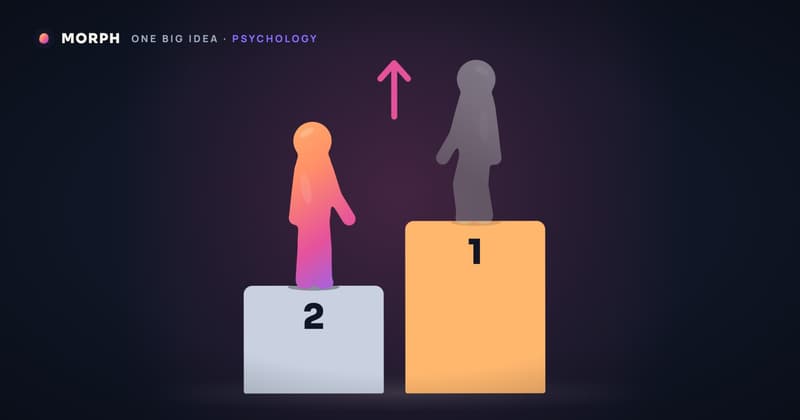
A week after the final, Maya is still losing it. She lost by one second. She knows the result, she has seen the photo, and she has told her coach she's fine. But on the bus, in the shower and just before sleep, the same thought comes back: if only I'd started faster. Each time it plays, she loses again.
In the first part of this story we looked at why a near miss can hurt more than a heavy defeat: the better result that almost happened is easy to imagine, so the real one feels like a loss. This article goes one step further. If that "if only" is going to keep coming back, what do you do with it?
The short answer from the research: an "if only" can help you, but only when it ends somewhere. Ask "at least what?" to take the sting out, then turn the thought into one fix for next time.
Why does an "if only" keep looping?
Psychologists call thoughts like "if only I'd started faster" upward counterfactuals: comparisons with a better outcome that didn't happen. "At least I made the final" is a downward counterfactual: a comparison with a worse outcome that didn't happen either.
Neal Roese and Kai Epstude have argued that upward counterfactuals exist for a reason [2]. They are the mind's way of finding what to change. "If only I'd started faster" contains a lesson, and the discomfort that comes with it is part of what makes you want to act on it. In their account, a counterfactual does its job when it leads to an intention ("next time I'll work on my start") and the intention leads to a change in behaviour.
The trouble starts when the second step never happens. The thought arrives, stings, and leaves without producing a plan, so nothing marks it as dealt with. It comes back the next day in the same form. Epstude and Roese note that counterfactuals which repeat without being turned into action are the ones linked to rumination and low mood [2].
Edward Watkins's review of repetitive thinking points the same way [6]. Going over a problem again and again isn't harmful in itself; it helps with recovery and planning in some conditions and feeds depression and anxiety in others. One of the factors that decides which way it goes is how abstract the thinking is. "Why does this always happen to me?" has no answer you can act on. "What exactly went wrong in the first ten metres?" does.
Illustrative walk-through based on Epstude & Roese (2008), Roese (1994) and Watkins (2008). Not data.
What did the experiments find?
The clearest evidence for the "job" of each kind of thought comes from Roese's 1994 experiments [1]. He asked students to think about an outcome in one of two ways: how it could have turned out better, or how it could have turned out worse.
People who generated downward counterfactuals ("it could have been worse") felt better afterwards than people who generated upward ones.
People who generated upward counterfactuals ("it could have been better") reported stronger intentions to do things that would improve the outcome next time.
On a word-puzzle (anagram) task, people prompted to think upward after the first round did better on the next round than those prompted to think downward.
So the two directions trade off. Downward thoughts help the feeling. Upward thoughts help the next attempt, at a price in mood.
Other studies fit this picture. Keith Markman and colleagues found that people who expected to play a gambling game again were more likely to generate upward counterfactuals than people who didn't expect another round [3]: the mind seems to reach for "if only" when there is a next time to prepare for. And in a month-long study of real university exams, Susan Nasco and Kerry Marsh found that students who tended to think upward after an exam reported more sense of control, and that sense of control went with better grades on the next exam [4]. That study was correlational, so it shows an association, not proof that upward thinking raised the grades.
Questions based on the published results of Roese (1994) and Markman et al. (1993); the answers describe the direction of the effects, not their size.
Step one: why ask "at least what?"
If upward thoughts are the useful ones, why start with "at least"?
Because while the near miss still hurts, it's hard to think about it concretely; the mind keeps returning to the loss itself. A downward counterfactual is the quickest way Roese found to improve mood [1]. "At least I made the final. Most runners never get that far" puts the result back in proportion without denying it.
There is a catch, and the 1994 experiments show it too. Downward thoughts feel better but carry no plan, and in Roese's data they went with weaker intentions to improve [1]. Treat "at least" as a brake: use it to take the heat out, then move on to the second question.
Step two: what makes a good fix?
Not every "if only" deserves a fix. Three questions sort them:
Is it about something you control? "If only it hadn't been windy" has nothing to act on. Epstude and Roese note that counterfactuals about your own actions are the ones that turn into useful intentions [2]. For uncontrollable causes, "at least" and acceptance do more work than any plan.
Will the situation come back? A fix is worth making for a race you'll run again, a type of exam you'll sit again, a meeting that happens every month. For a one-off, the lesson may be smaller and more general.
Is it specific enough to do? "Be better at starts" is a wish. "Practise starts twice a week" is a plan. "When the gun fires, eyes down, drive" is a plan you can't forget to use, because it's attached to the moment it's needed.
A simple decision aid based on the ideas in this article. It is not a validated test or therapy.
That last form has a name. Peter Gollwitzer calls it an implementation intention: an if-then plan that links a situation ("when the gun fires") to a response ("drive"). A meta-analysis by Gollwitzer and Paschal Sheeran pooled 94 independent tests and found that forming if-then plans had a medium-to-large effect on reaching goals, with an average effect size of d = 0.65 [5]. The effect varied across studies and goals, and the plans were tested on many kinds of behaviour, not on regret in particular. But the format suits an "if only" well, because the counterfactual has already named the moment: if only I'd started faster points straight at the start.
Illustrative conversion of the meta-analytic average effect (Gollwitzer & Sheeran, 2006) to Cohen's U3, assuming normally spread outcomes. Not a success rate.
Why only one fix?
Because one fix is something you will actually do, and a list of seven usually isn't. When a loss replays, it can produce a dozen "if only"s: the start, the sleep the night before, the warm-up, the shoes. Picking the one you control, that will come back, and that you can attach to a moment gives the loop a place to end. Once it's written down as an if-then, the thought has done its job, and when it comes back you can answer it: "I know. That's the plan."
This is a self-help reading of the research, not therapy. If a loss keeps replaying for weeks and comes with low mood, poor sleep or thoughts that frighten you, that's worth talking through with a professional.
What can you do the next time it replays?
When an "if only" loops, run the three steps in order:
Notice the loop. The same thought, in the same words, with no new information.
Ask "at least what?" Find one true downward comparison and say it once. It lowers the heat; it doesn't close the case.
Pick one fix, as an if-then. Choose the "if only" you control and that will come round again, and write it as "When ___, I will ___."
Maya's version is short: At least I made the final. When the gun fires, eyes down, drive. The next time the replay starts on the bus, she doesn't need to watch it to the end. She already knows what it was trying to tell her.
Sources
Roese, N. J. (1994). The functional basis of counterfactual thinking. Journal of Personality and Social Psychology, 66(5), 805–818. Lab experiments with students: mood after recalled events, intentions, and a repeated anagram task. It did not test real-life goals over time.
Epstude, K., & Roese, N. J. (2008). The functional theory of counterfactual thinking. Personality and Social Psychology Review, 12(2), 168–192. A theoretical review; it summarises when counterfactuals help and when they turn into rumination, rather than reporting one new study.
Markman, K. D., Gavanski, I., Sherman, S. J., & McMullen, M. N. (1993). The mental simulation of better and worse possible worlds. Journal of Experimental Social Psychology, 29(1), 87–109. Lab gambling task with students; whether a repeat was expected changed the direction of counterfactuals.
Nasco, S. A., & Marsh, K. L. (1999). Gaining control through counterfactual thinking. Personality and Social Psychology Bulletin, 25(5), 557–569. A month-long study of real exams; correlational, so it can't show that upward thinking caused the better grades.
Gollwitzer, P. M., & Sheeran, P. (2006). Implementation intentions and goal achievement: A meta-analysis of effects and processes. Advances in Experimental Social Psychology, 38, 69–119. 94 tests across many goals (health, study, environment); the average hides wide variation, and none of the tests was about regret.
Watkins, E. R. (2008). Constructive and unconstructive repetitive thought. Psychological Bulletin, 134(2), 163–206. A review: repetitive thinking helps or harms depending on its content, context and how abstract or concrete it is.
One email when we publish. Research, product decisions, and what teams report back.