Sources checked 30 October 2026. The workplace and home conversations below are worked examples, not quotes from any study.
You ask a colleague a simple question: why did the delivery slip? You expect a date, a reason, maybe an apology. Instead you get a question back: why aren't you asking about sales? They were late too. Then a third thing comes up, and a fourth. Ten minutes later you are defending your own record, and nobody has said a word about the delivery.
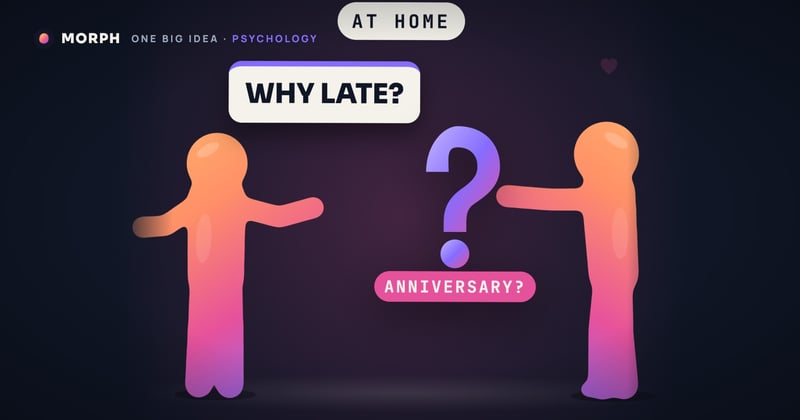
At home it sounds different but works the same way. Someone comes home hours late without a message. You ask what happened. The answer is: what about when you forgot our anniversary?
That move has a name. It is called whataboutism, and once you can see it, it gets much harder to use on you.
What is whataboutism?
Whataboutism is answering a criticism by pointing to someone else's fault, usually the critic's, instead of answering the criticism itself. "You did X" is met with "what about Y?" Philosophers have an older name for the closest version, tu quoque, Latin for "you too": the claim that a criticism doesn't count because the person making it is guilty of something similar. [5]
The key feature is the swap. The original question is about one thing. The reply changes the subject to a different thing, and then treats the conversation as if the first question had been answered. It hasn't. Whether sales were also late tells you nothing about why delivery slipped. Whether someone forgot an anniversary last year says nothing about where their partner was tonight.
Worked examples written for this article, not quotes from a study.
Where the word comes from
The name is younger than the habit. On 30 January 1974, The Irish Times printed a letter from Sean O'Conaill, a history teacher in Coleraine, Northern Ireland. He described people who met every condemnation of IRA violence with a list of the other side's wrongs, and he called them "the Whatabouts". A few days later, the columnist John Healy, writing as "Backbencher", turned the idea into a word: whataboutery. Writers on the Troubles used it for years afterwards. [1]
The version with -ism spread later through writing about the Soviet Union and Russia. The journalist Edward Lucas used it in The Economist in 2008 to describe a Cold War propaganda habit: any Western criticism of the Soviet Union was answered with a complaint about the West, a habit Western observers had already nicknamed "whataboutism". [2] The word moved from geopolitics into everyday arguments because the move itself is everywhere.
Why it works so well
It would be easy to think whataboutism only fools careless listeners. The evidence says otherwise.
In 2024, the political scientists Wilfred Chow and Dov Levin published two survey experiments with American adults in the journal International Organization. People read about the United States criticising another country's misconduct. Some of them then read a whataboutist reply: the criticised country pointed to a similar American failing. That reply lowered support for the original criticism and for penalising the other country. Pointing to a similar, recent misconduct worked better, and US counter-messaging often failed to undo the effect. [3]
The study was about countries, not coworkers, and a survey vignette is not a real argument. But the mechanism is easy to recognise at a smaller scale. A counter-accusation does three things at once:
It moves attention. The listener's mind follows the new, often more emotional, topic.
It attacks standing. If the critic is also guilty, the critique starts to feel hypocritical, and hypocrisy is something we punish quickly.
It creates a debt. Now you feel you must answer the new charge before you can go on, and the original question is quietly dropped.
None of this needs to be planned. Many people reach for "what about you?" on reflex when they feel cornered, because it relieves the pressure in the moment. That is worth remembering: noticing the move tells you the question was dropped, not that the other person is a schemer. The fix is the same either way: bring the conversation back to the question that was asked.
Illustrative conversation. Real arguments are messier; the pattern is what to notice.
Is "what about" ever fair?
Yes, and this matters, because the label "whataboutism" can itself be used to shut down a fair point.
Raising another problem is fair when it is genuinely connected to the decision in front of you. If a team is deciding whether to blame delivery for a lost client, the fact that sales also promised a date they couldn't keep is relevant to that decision. Pointing out a double standard can also be fair: if a manager punishes one person's lateness and ignores another's, "what about them?" is a question about consistency, not a dodge.
The test is what happens to the first question. Fair comparisons add to it: both things are true, and both need an answer. Whataboutism replaces it: the second issue is offered instead of an answer. A short way to remember it: a second problem doesn't make the first one disappear.
A thinking aid based on the distinction in this article, not a diagnostic tool.
Can you learn to spot it?
There is good evidence that learning the names of manipulation techniques helps people notice them. In 2022, a team from the Universities of Cambridge and Bristol and Google Jigsaw showed short "prebunking" videos about techniques such as false dichotomies and ad hominem attacks to nearly 30,000 people, including a field test inside YouTube ads. Viewers got better at recognising the technique in new examples. [4]
A 2025 follow-up in Political Psychology built short inoculation videos against three logical fallacies common in misinformation, including whataboutism, the straw man and moving the goalposts, and tested them on more than 1,600 people. The videos increased detection of the fallacies compared with a control group, though only the straw man video clearly improved people's ability to tell fallacious content apart from fair content. [6] In other words, naming the trick helps you notice it. Telling it apart from a fair comparison still takes judgement.
How to answer it without a fight
The worst response is usually to defend yourself point by point. Every "but that was different" accepts the new topic and drops the first one. A calmer move is to acknowledge, park, and return:
Acknowledge the second issue without debating it: "That's worth discussing."
Park it, with a real promise to come back: "Let's do that separately."
Return to the original question, in the same words if you can: "Can we answer the original question first? Why did delivery slip?"
Then actually come back to the parked issue. If you never do, the other person was right to suspect you only wanted to win. Parking is not dismissing.
Some situations need more than a script. If every concern you raise turns into a review of your past mistakes, and you leave every conversation apologising, that pattern may be part of something bigger, such as a habit of reversing blame. Talking it through with someone you trust, or a counsellor, can help.
Example wording to adapt; it does not know your situation.
The question to keep
Next time a question about one mistake turns into a list of five, notice the swap. You don't have to win the new argument, and you don't have to pretend the second problem isn't real. Ask one thing: has the first question been answered yet?
Sources
[1] Pascal Tréguer, Word Histories, "The coinage of an Irish political term: 'whataboutery'" (2018), and The Irish Times, "In a Word… Whataboutism". Trace the 30 January 1974 letter by Sean O'Conaill and John Healy's "Backbencher" column, drawing on lexicographer Ben Zimmer. Sources differ on whether O'Conaill or Healy should get credit for the coinage.
[2] Edward Lucas, "Whataboutism", The Economist, 31 January 2008. Describes Soviet-era rhetoric; Lucas popularised the term rather than inventing it.
[3] Wilfred M. Chow & Dov H. Levin, "The Diplomacy of Whataboutism and US Foreign Policy Attitudes", International Organization 78(1), 2024, 103–133. Two survey experiments with US adults about international criticism; effects on everyday interpersonal arguments were not tested.
[4] Jon Roozenbeek, Sander van der Linden, Beth Goldberg, Steve Rathje & Stephan Lewandowsky, "Psychological inoculation improves resilience against misinformation on social media", Science Advances, 2022. Seven studies, including a YouTube field test; whataboutism was not one of the techniques tested.
[5] Hans Hansen, "Fallacies", Stanford Encyclopedia of Philosophy. Background on tu quoque and related fallacies of relevance.
[6] Mikey Biddlestone, Jon Roozenbeek, Jane Suiter, Eileen Culloty & Sander van der Linden, "Tune in to the prebunking network! Development and validation of six inoculation videos that prebunk manipulation tactics and logical fallacies in misinformation", Political Psychology 46, 2025, 1858–1886. Online experiments; measured recognition shortly after viewing, not long-term behaviour in real conversations.
Watch the episode
One email when we publish. Research, product decisions, and what teams report back.