Sources checked 27 October 2026. The study figures below are as published; the day simulator is an illustrative model, not a measurement of you.
A student sits down with one exam to prepare for and one phone on the desk. She opens her notes. Her phone lights up: a message. A minute later, a video someone sent. Then a reminder, then a like, then a group chat. She answers none of them. After an hour she has read four pages and remembers two, and the story she tells herself is the usual one: I'm just lazy.
Maybe. But there is another explanation that is easier to test and easier to fix. She may not be short of willpower. She may be surrounded by too many things competing for the same attention.
What does an interruption actually cost?
The best-known numbers on this come from Gloria Mark, who has studied how people work at their computers since the early 2000s. In a 2005 study at UC Irvine, her team shadowed 24 information workers minute by minute. They grouped the day into "working spheres", the projects people were moving between, and found that about 57% of those working spheres were interrupted. Interrupted work was usually picked up again the same day, but typically only after people had moved through more than two other activities first. [1]
You may have heard a sharper version of this: "it takes 23 minutes to get back on task". That figure comes from Mark's descriptions of this line of research in talks and interviews; the paper itself reports averages from a small, observational sample at one company. Read it as "getting back is slow and indirect", not as a constant of nature.
A 2008 lab experiment by Mark, Daniela Gudith and Ulrich Klocke adds a twist. People who were interrupted while doing an email task actually finished faster than people who weren't, but they reported more stress, frustration, effort and time pressure. [2] Interruptions don't always make you slower. They can make the same work cost more.
Illustrative model: alert timing, settle-back time and replies are assumptions you set, not measured values.
Does a notification hurt if you ignore it?
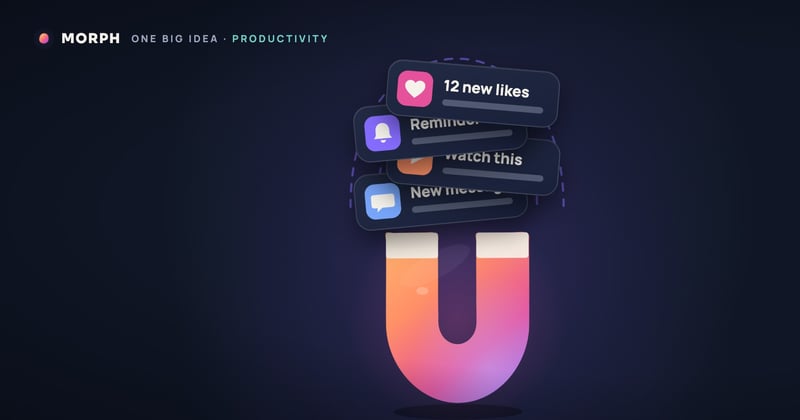
This is the part that surprises people. In 2015, Cary Stothart, Ainsley Mitchum and Courtney Yehnert gave 166 students a demanding attention task, a long run of digits where you must respond to every one except a rare target. Partway through, some participants' phones received a call or a text notification. They didn't answer. They didn't look. They still made more errors than participants whose phones stayed silent, and the disruption was comparable in size to what earlier studies found when people actually used their phones. [3]
The authors' explanation is modest: an alert starts a train of thought ("who was that?", "I'll check after this") that competes with the task in front of you. You don't need to pick the phone up for it to take something.
Is the phone on the desk a problem even when it's silent?
Here the evidence gets mixed, and it is worth being honest about that. A widely shared 2017 study by Adrian Ward and colleagues, run with about 800 participants, reported that people did worse on working-memory tests when their own phone was on the desk than when it was in another room, even with the phone silenced and face down. [4]
Later researchers tried to repeat it. A pre-registered direct replication published in 2022 found no difference between phone locations, [5] and a 2023 study by Matthias Hartmann and colleagues also found no evidence for the effect. [6] A 2023 meta-analysis that pooled 22 studies did find an overall negative effect of smartphones on cognitive performance, but it combined studies of using the phone with studies of its mere presence, and not every cognitive skill was affected. [7]
So the fair summary is: alerts that arrive while you work have decent evidence behind them; a silent phone simply sitting nearby is uncertain. Moving it away costs nothing, so it's a reasonable precaution, not a proven cure.
Summaries of the published studies listed in Sources [1]–[9], with what each did not test.
What happens when you turn notifications down?
Two field experiments are useful here because they changed real people's phones for real weeks. In Kostadin Kushlev, Jason Proulx and Elizabeth Dunn's 2016 study, participants spent one week with notifications on and another with them off. During the alert-heavy week they reported more symptoms of inattention and hyperactivity. [8] A 2019 follow-up led by Nicholas Fitz found that people whose notifications were delivered in batches three times a day felt more attentive, more productive, in a better mood and more in control of their phones than people in a control group. [9]
Neither study tested exam grades or long-term outcomes, and both relied on people describing their own attention. But they point the same way as the lab work: fewer interruptions, steadier attention.
Is "dopamine fasting" real?
Not in the way it is usually sold. The popular story says a day without your phone "resets" your dopamine, so ordinary tasks feel rewarding again. That's scientifically misleading. Dopamine is not a tank that drains and refills over a weekend, and a short break from social media has not been shown to reset anything in the brain.
The psychologist who popularised "dopamine fasting", Cameron Sepah, has himself said the name is not literal: the technique is stimulus control, a standard part of cognitive behavioural therapy. You reduce the cues that trigger a habit, so the habit fires less often. [10] Harvard Health Publishing made the same point when the fad spread: the useful part is the behaviour change, not a chemical reset. [11]
That is why this article says attention fasting. It describes what you actually do: remove things that compete for your attention before demanding work. No neurochemistry required.
Four common claims checked against Sources [3]–[11].
How do you run an attention fast?
Keep it small and specific to one task. Before you start the hard thing, subtract before you add: remove a distraction before you go looking for motivation.
Silence the alert, not just the sound. Turn off banners and badges for the apps that interrupt most, or use a focus mode for the length of the task.
Move the phone out of reach. The evidence for this alone is mixed, but it also removes the easy option of checking.
Close the extra screens. One window, one tab, one document.
Batch the checking. Decide when you'll look (for example, at the end of a 45-minute block) so your brain doesn't keep a note open to check now.
Leave a re-entry note. Mark's later work suggests resuming is the slow part, so write the next step down before you stop. [1]
A thinking aid for one task, ordered by how directly the evidence links each item to attention costs. Not medical advice.
The question to keep
The student in the story didn't find more motivation. She removed the things pulling at her, and the work had room to hold her. Before your next hard task, ask: what's one thing I can take away first?
Sources
[1] Gloria Mark, Victor M. González & Justin Harris, "No task left behind? Examining the nature of fragmented work", CHI 2005. Observational study of 24 information workers at one company; the much-quoted "23 minutes" figure is a popular summary of this research, not a universal constant.
[2] Gloria Mark, Daniela Gudith & Ulrich Klocke, "The cost of interrupted work: more speed and stress", CHI 2008. A short lab experiment with an email task; measured speed, errors and self-reported workload, not long-term performance.
[3] Cary Stothart, Ainsley Mitchum & Courtney Yehnert, "The attentional cost of receiving a cell phone notification", Journal of Experimental Psychology: Human Perception and Performance, 2015. 166 students; a single lab task (SART); notifications were not answered.
[4] Adrian F. Ward, Kristen Duke, Ayelet Gneezy & Maarten W. Bos, "Brain Drain: The mere presence of one's own smartphone reduces available cognitive capacity", Journal of the Association for Consumer Research, 2017. Several later replications did not find the effect.
[5] Ruiz Pardo & Minda, "Reexamining the 'brain drain' effect: A replication of Ward et al. (2017)", Acta Psychologica, 2022. Pre-registered direct replication of Ward's second experiment; no difference between phone locations.
[6] Hartmann et al., Consciousness and Cognition, 2023. Partial replication and extension; no evidence for the brain drain effect.
[7] Böttger, Poschik & Zierer, "Does the Brain Drain Effect Really Exist? A Meta-Analysis", Behavioral Sciences, 2023. 22 studies, 43 effects; pools phone use and phone presence, so it does not isolate presence alone.
[8] Kostadin Kushlev, Jason Proulx & Elizabeth W. Dunn, "'Silence Your Phones': Smartphone notifications increase inattention and hyperactivity symptoms", CHI 2016. Two-week field experiment; outcomes were self-reported symptoms, not clinical diagnoses.
[9] Nicholas Fitz, Kostadin Kushlev et al., "Batching smartphone notifications can improve well-being", Computers in Human Behavior, 2019. Field experiment; self-reported attention, productivity and mood.
[10] Cameron Sepah, "The Definitive Guide to Dopamine Fasting 2.0", 2019. The originator's own description: a stimulus-control technique from CBT, and explicitly not a literal reduction of dopamine.
[11] Peter Grinspoon, "Dopamine fasting: Misunderstanding science spawns a maladaptive fad", Harvard Health Blog, 2020. Explains why the "reset" framing misreads how dopamine works.
Watch the episode
One email when we publish. Research, product decisions, and what teams report back.